

How to Choose Bauhaus Vintage Lighting
What the Bauhaus really changed about light — and what to look for when choosing an original or Bauhaus-related vintage lamp.
A lamp can do more than illuminate a room.
It can direct the eye, define a working surface, soften architecture or make the structure of an interior suddenly clearer. At the Bauhaus, this relationship between light, function and form became part of a much larger experiment: how should objects be designed for modern life?
The answer was not simply “make them minimal”.
Bauhaus lighting emerged from workshops where craft, technology, materials and the possibilities of industrial production were being reconsidered together. Glass, nickel-plated metal, lacquered steel and simple geometric forms were not chosen merely to create a recognisable style. They were part of an attempt to design useful objects for a changing world.
That distinction still matters today.
Because not every spherical shade, chrome arm or geometric table lamp is Bauhaus.
What does “Bauhaus lighting” actually mean?
The Bauhaus existed for only fourteen years, from 1919 to 1933, first in Weimar, then Dessau and finally Berlin.
Its influence, however, spread far beyond the school itself.
This creates an immediate problem for collectors. The term Bauhaus lighting is now used so broadly that it can describe genuine objects created within the Bauhaus workshops, lamps designed by former Bauhaus figures, German modernist lighting from the same period, later objects influenced by Bauhaus principles, and contemporary products that simply borrow the visual language.
These categories are not interchangeable.
A lamp designed or developed within the Bauhaus carries a direct institutional connection. A lamp by someone who studied or taught there may belong to a later phase of that designer’s career. Another fixture may have no direct Bauhaus connection at all, yet still reflect the wider European modernist vocabulary of functional forms and industrial materials.
For that reason, shape alone is never enough to establish attribution.
The designer, manufacturer, model, date, construction and documentary evidence all matter.
The Bauhaus lamp was not born fully formed
One of the most famous lamps associated with the school demonstrates exactly why design history is often more complicated than a single famous name.
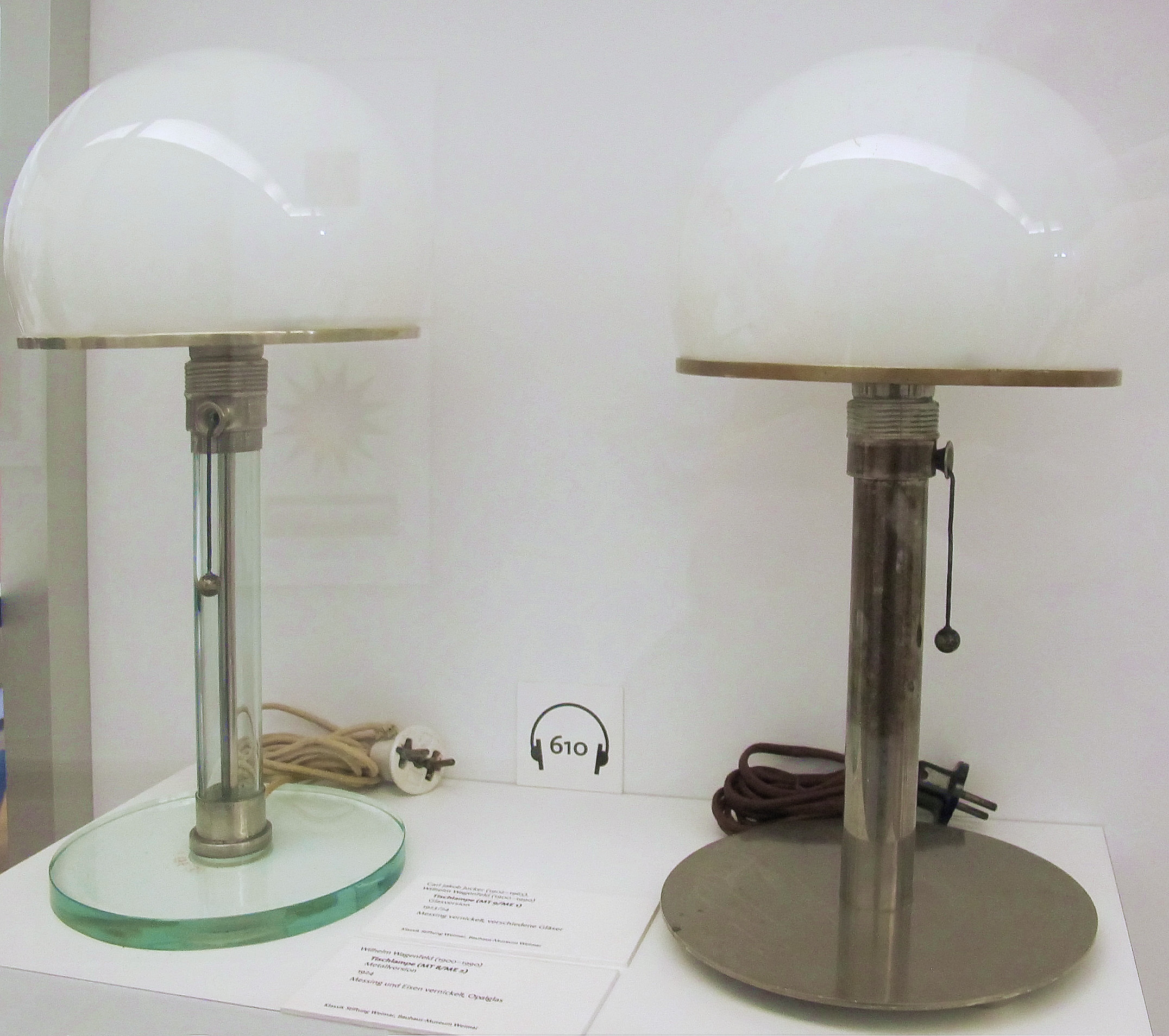
The table lamp commonly known as the Bauhaus Lamp is usually associated with Wilhelm Wagenfeld. But its development also involved the Swiss designer Carl Jakob Jucker.
In preparation for the first Bauhaus exhibition in 1923, Jucker developed a table lamp with a glass base and glass stem in the Weimar metal workshop. When he left the school later that year, the problem of the shade had not yet been fully resolved. Wilhelm Wagenfeld, who had arrived at the Bauhaus in autumn 1923, continued the development in 1924.
Wagenfeld produced a version with a metal base, nickel-plated shaft and opal glass shade. Further experimentation combined elements of the two designs. According to the Klassik Stiftung Weimar, even the dimensions of the glass shade were refined through trial and error because early shades could crack under the heat generated by the bulb.
The object we now recognise as a design icon was therefore also a practical experiment.
Bauhaus design was not simply geometry imposed on an object. It was geometry tested against use, material and production.
There is another revealing detail. Despite its modern appearance, the early lamp was initially too complex to be especially attractive for industrial manufacture. The Bauhaus later included it in its catalogue of models, and industrial series production followed only later.
An object that came to symbolise industrial modernism began life as a carefully worked prototype.
Marianne Brandt: when the workshop met the factory
If the Wagenfeld–Jucker lamp illustrates experimentation within the workshop, Marianne Brandt’s career shows what happened when Bauhaus ideas moved closer to industrial production.
Brandt entered the Bauhaus in 1923 and became one of the most important figures in its metal workshop. As director of the workshop in 1928–29, she helped establish a relationship with the Leipzig lighting manufacturer Körting & Mathiesen, known through its Kandem brand.
This collaboration mattered. Instead of producing isolated experimental objects, Brandt and other Bauhaus designers increasingly developed lamps with standardized components and serial manufacture in mind.
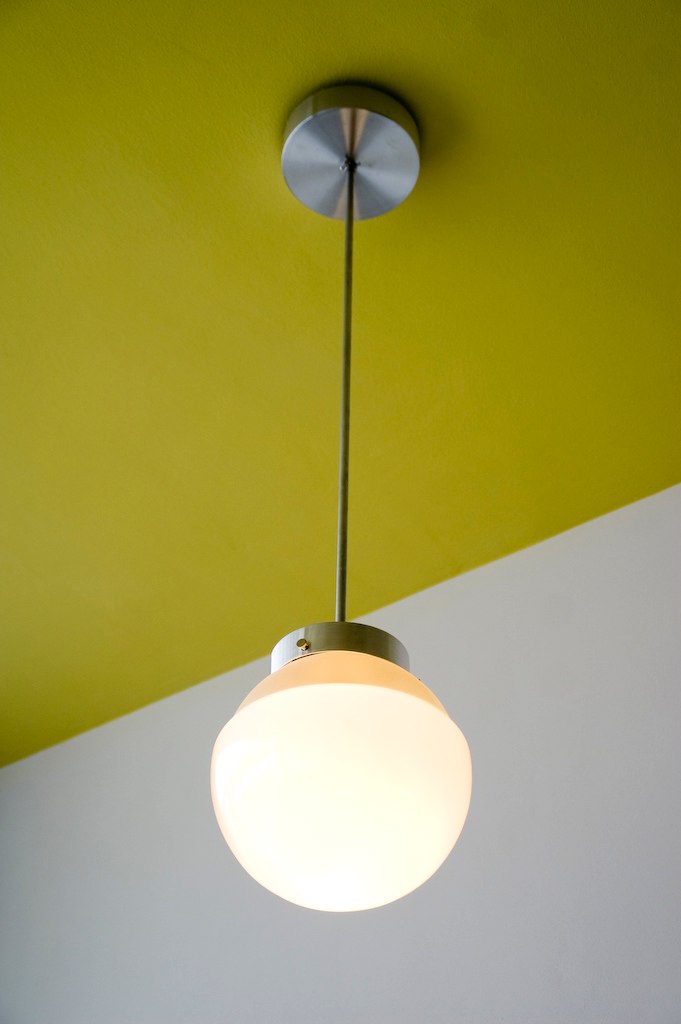
The Metropolitan Museum of Art documents this transition particularly well through the later Kandem Ceiling Light No. 777, designed by Marianne Brandt and Hin Bredendieck. Its standardized construction was conceived for manufacture, while the treatment of the glass itself controlled the quality of light: one part of the shade produced more direct illumination, another diffused it.
This is Bauhaus thinking at its most convincing.
The geometry is elegant, certainly.
But the real design decision is about what the light does.
Christian Dell and the broader modernist story
Another important name is Christian Dell.
Dell was closely connected to the Bauhaus metal workshop in Weimar during the early 1920s and later became an important lighting designer in his own right. His subsequent career is a useful reminder that Bauhaus influence cannot be contained neatly within the years of the school itself.
His later lamps — including designs associated with the Kaiser Idell family — belong to the broader history of German modernist lighting. They reflect a disciplined attention to material, articulation and function, but they were not simply products of the Bauhaus school.

So describing every Christian Dell lamp simply as “Bauhaus” would flatten an interesting design history.
A more precise description might be Bauhaus-related, German modernist, or might explicitly mention Dell’s Bauhaus connection, depending on the particular object and date.
Precision does not make an object less desirable.
Usually, it makes its story more interesting.
Geometry is evidence — but not proof
So what should we actually look for in Bauhaus and Bauhaus-related vintage lighting?
Geometry remains important.
Spheres, cylinders, cones, discs and straight tubular elements appear repeatedly. But the strongest examples rarely feel as though geometric shapes have been assembled merely for visual effect.
The relationship between the parts is functional.
A globe diffuses light. A pivoting joint changes direction. A shade controls glare. A weighted base creates stability. An adjustable arm allows a lamp to move with the user.
This is why genuine modernist lighting can feel simultaneously simple and extremely considered.
Materials tell another part of the story. Nickel-plated or chromed metal, lacquered steel, aluminium, glass and opal glass all belonged to the vocabulary of modern industrial design.
But these materials were widely used beyond the Bauhaus too.
A chrome tube and an opaline globe do not constitute an attribution. They are clues — nothing more.
Original, period, Bauhaus-related or Bauhaus-inspired?
For collectors, this may be the most useful distinction in the entire subject.
Original Bauhaus object
Designed or produced within a documented Bauhaus context.
Bauhaus-related object
Designed by a figure closely connected to the school, sometimes after leaving it.
Period modernist object
Produced during the same broader European modernist period, but without a demonstrated Bauhaus connection.
Later Bauhaus-influenced design
A later vintage object that clearly draws from Bauhaus or interwar modernist principles.
Contemporary Bauhaus-style object
A recent design using the visual vocabulary without historical connection.
None of these categories automatically determines whether a lamp is good or bad.
But they should not be confused.
This is particularly important in the vintage market, where the word “Bauhaus” can easily become a shortcut for any object that looks sufficiently geometric.
A careful seller should distinguish documented history from stylistic resemblance.
What should you check before buying?
Condition matters, but perfection should not be the goal.
A vintage lamp is allowed to look old.
Light surface wear, oxidation, softened finishes or minor signs of use may be entirely consistent with its age. More important questions concern the integrity of the object.
Is the shade original? Has the base been refinished? Are the joints, switches and adjustment mechanisms consistent with the period? Has metal been aggressively polished? Are screws, fittings or electrical components later replacements? Has the lamp been altered structurally?
The glass deserves particular attention. Original shades are frequently lost or damaged over decades, and replacements can significantly change both the appearance and the historical integrity of a lamp.
Manufacturers’ marks, stamped numbers, labels and construction details can also provide useful evidence.
But again, no single clue should carry the entire attribution.
A label can be transferred. A shade can be replaced. A particular fitting can remain in use for decades.
Reliable identification usually comes from several details agreeing with one another.
Rewiring: preservation must still be safe
Electrical safety deserves separate attention.
A lamp may be historically fascinating and still contain wiring that should no longer be used. Old insulation can deteriorate. Plugs and sockets may no longer comply with current standards, while earthing requirements differ between periods and countries.
For a lamp intended for regular use, inspection by a qualified professional is sensible.
Rewiring does not automatically destroy historical integrity. Done carefully, it can allow an important object to remain functional while preserving original components wherever safely possible.
If a lamp has been rewired, documentation is useful: what was changed, what was retained and why?
The goal should not be to pretend that nothing happened.
It should be to make the intervention appropriate, safe and intelligible.
Patina is not authenticity
The vintage market has developed an understandable affection for patina.
But patina should never become a substitute for evidence.
A worn nickel surface may be original. It may also be the result of later treatment. A yellowed switch may belong to the lamp — or it may have been replaced decades later.
Ageing tells us that an object has a history.
It does not necessarily tell us what that history is.
This is why over-restoration can be problematic. Aggressive polishing, repainting or replacing seemingly insignificant components may erase clues that could have helped identify the object later.
The best conservation decisions often preserve information as well as appearance.
What determines value?
Vintage lighting should not be purchased on the assumption that its market price will inevitably rise.
There is no such guarantee.
A lamp’s value may depend on a combination of factors: documented designer, manufacturer, rarity, model, age, original components, condition, provenance, restoration history and current collector demand.
Some extremely good modernist lamps were produced in substantial quantities. Others are scarce. Some famous designs have been repeatedly reissued, which makes determining the exact production period particularly important.
In other cases, an anonymous lamp may be beautifully designed and entirely authentic to its period without commanding the price associated with a celebrated name.
Design quality and market value overlap, but they are not the same thing.
For a buyer, perhaps the more useful question is not simply: Will this lamp increase in value?
But: Do I understand what I am buying?
That is a much stronger starting point.
How to use Bauhaus-related lighting in a contemporary interior
Historically informed does not have to mean historically staged.
Some of the most convincing interiors use modernist lighting in rooms containing objects from several periods.
A nickel-plated table lamp can introduce precision beside aged wood. An opal glass pendant can soften a room dominated by angular furniture. A functional desk lamp can work equally well with Scandinavian cabinetry, a contemporary table or an older writing desk.
The important consideration is usually scale before style.
Consider where the light falls. Is the object decorative, task-oriented or ambient? How bright is the exposed source? Does the shade diffuse the light? Can the lamp be adjusted? What happens when it is switched on?
This last question is particularly important.
A lamp is one of the few design objects whose visual character can change completely in use.
We do not experience lighting only as an object.
We experience the space it creates around itself.

Why Bauhaus lighting still matters
The enduring importance of Bauhaus lighting does not lie in a catalogue of familiar shapes.
It lies in a change of attitude.
The lamp was no longer understood simply as an ornamental object carrying electric light. It could be a problem to solve.
How should light be distributed? Which materials are appropriate? How can a fitting be adjusted? Can components be standardized? Can an object be manufactured efficiently without losing formal clarity?
The Bauhaus did not answer all these questions alone, and it was part of a much wider modernist transformation taking place across Europe.
But its workshops became one of the places where these questions were asked with unusual intensity.
That is what makes the best Bauhaus and Bauhaus-related lighting so compelling today.
Not because it looks “minimal”.
Not because chrome and glass have become shorthand for modernism.
But because, at its best, every visible decision has a reason.
The Artibus365 approach
At Artibus365, we believe that the history of an object should be described as precisely as the available evidence allows.
Where a designer, manufacturer or model can be documented, that information matters.
Where only the period, construction or stylistic context can be established, that distinction matters too.
A good vintage lamp does not need an exaggerated attribution to become interesting.
Sometimes the most rewarding objects are precisely those that invite further research.
Because collecting design is not only about recognising famous forms.
It is also about learning to look more closely.
Sources and further reading
- Klassik Stiftung Weimar — Wilhelm Wagenfeld / Carl Jakob Jucker, Tischleuchte MT 9/ME 1, 1924
- The Metropolitan Museum of Art — Marianne Brandt and Hin Bredendieck, Kandem Ceiling Light No. 777
- The Museum of Modern Art — Christian Dell
- Wikimedia Commons — Jucker / Wagenfeld image source and CC BY-SA 3.0 licence
- Wikimedia Commons — Marianne Brandt HMB 29 image source and CC BY 2.0 licence
- Wikimedia Commons — Christian Dell / Kaiser Idell image source and CC BY-SA 4.0 licence
Leave a comment